 News Home
 {{blogcategory.sCategoryName}}
Recent posts
Extravaganza
How to Light a Room Like an Interior Designer
22 July 2026

Money Talks
What You Should Know About ClickCredit Loan Rates and Terms
17 July 2026

Hit the Road
What Happens When Commercial Flights Are Diverted?
15 July 2026

Talent Agents
The Complete Guide to Building and Managing a Remote Team
13 July 2026
Popular posts
Extravaganza
Trending Music Hashtags To Get Your Posts Noticed
24 August 2018
Geek Chic
How To Fix iPhone/iPad Only Charging In Certain Positions
05 July 2020
Extravaganza
Trending Wedding Hashtags To Get Your Posts Noticed
18 September 2018
Money Talks
How To Find Coupons & Vouchers Online In South Africa
28 March 2019
How to Light a Room Like an Interior Designer
22 July 2026 | 0 comments | Posted by Amber Nel in Extravaganza
To light a room like an interior designer, you need three things: a perfect 3-layer layout strategy, fixture placement, and visual balancing skills. By mastering these three areas, you can literally light up any room - living space, bedroom, dining room like a pro.
So, in this quick guide, we will explore them one by one, in simple, easy-to-follow language.
Let’s begin:
Crafting the 3-layer layout strategy
Understanding layering is the key to great lighting design. Every room requires three functional layers:
- Ambient light: It’s the basic general illumination you need to move around a room without bumping into the furniture. You can say it’s the canvas on which you paint your room’s entire lighting design. Always put ambient lights on dimmer switches so you can scale the brightness from bright daytime levels to a soft, relaxing glow at night.
- Task lighting: It’s highly targeted light meant for illuminating particular areas for performing specific tasks. For example, table lamps allow you to see the book or keyboard clearly, and pendants hanging from the kitchen ceiling prevent you from hurting your fingers when cutting vegetables. Remember that task lighting doesn’t have to be practical only. Layering means using task lights in conjunction with other layers to create an overall effect.
- Accent lighting: Accent lighting is pretty intentional, meant to highlight features like a photo frame, fireplace, or an artwork. Also called directional light, it can be sourced from wall sconces, pendants, chandeliers, lamps, or even small recessed bulbs. It’s 3X stronger than ambient light.
To elevate your layering, consider the "fourth dimension" of lighting: time. An interior designer doesn't just look at how a room looks at noon; they consider the transition from dusk to late evening. Use automated scenes to shift the balance of these layers throughout the day.
For instance, your ambient layer might be at 80% during sunset but drop to 10% by 10 PM, allowing your accent and task lights to create a more intimate, architectural silhouette within the space.
This dynamic approach ensures that the "canvas" of your ambient light is always responsive to the natural rhythm of your life.
Fixture placement
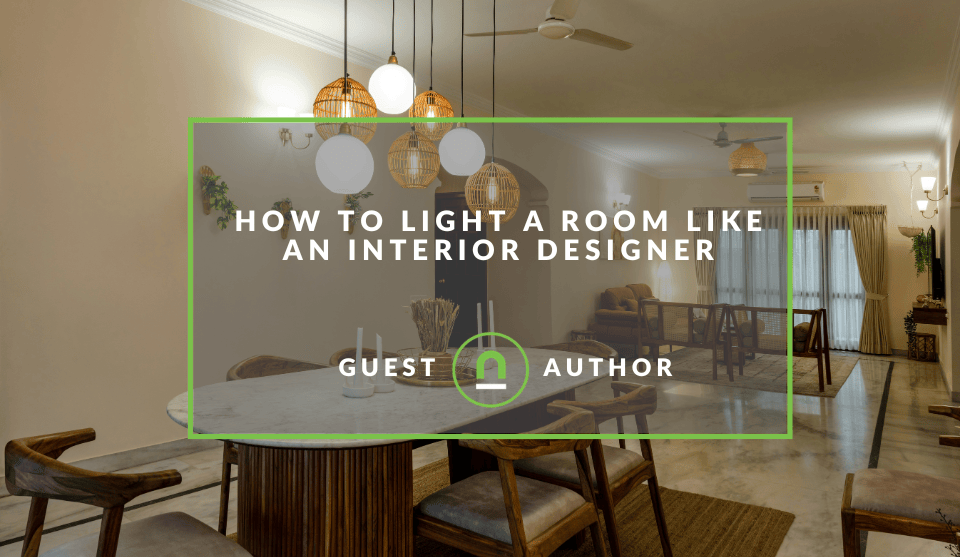
Of course, pendants are popular as they can perfectly balance charm, boldness, and wearability. Apart from that, there is a great variety of fixtures you can use to brighten your rooms.
Sculptural chandeliers add a dramatic focal point to larger spaces like living and dining areas. Architectural wall sconces highlight key areas like beds and fireplaces without occupying tabletops.
For low ceilings, flush-mount lamps emit wide, even ambient light without creating an overwhelming feel. Then, there are portable floor and table lamps that add life to the room without requiring installation or rewiring.
Create a cosy, custom look in a room using a combination of fixtures.
Visual balancing skills
Now comes the technical part that involves properly scaling your fixtures and choosing the right bulb specifications.
- Visual scale: It’s about the size and placement of fixtures. A fixture that's too small looks cheap, while one that's too large overwhelms the room. Interior designers apply this simple equation: The hanging light must be located 30-36 inches above the table and 7 feet above the floor.
- Light warmth: It refers to the bulb's Kelvin rating, which determines its light colour temperature. Designers stick to warm-white bulbs (2700K) for living rooms and bedrooms, and 3000K for kitchens and bathrooms to make spaces feel luxurious and inviting.
- The Rule of Three and Negative Space: Professional designers often group fixtures in odd numbers—specifically threes—to create visual interest and movement. However, balance also requires "negative space." Not every corner of a room needs to be illuminated. By leaving some areas in soft shadow, you create depth and drama, making the lit areas pop more effectively. This contrast is what separates a sterile, flatly lit room from a sophisticated, designed space. When placing lamps, think of them as anchors for furniture groupings; a floor lamp shouldn't just be "in the corner," it should be intentionally paired with an armchair to create a dedicated reading nook.
Smart Lighting Integration
Modern interior design is increasingly defined by smart technology that offers unprecedented control over atmosphere and efficiency. Smart lighting integration allows you to synchronise your 3-layer strategy into cohesive "scenes" controlled via smartphone, voice, or automated sensors. Beyond simple convenience, smart systems offer "Circadian Lighting"—technology that adjusts the colour temperature of your bulbs throughout the day to match the sun's natural cycle, supporting better sleep and productivity.
When integrating smart tech, focus on centralised hubs that can manage multiple fixtures simultaneously. This allows you to create a "Movie Night" scene where ambient lights fade to zero, task lights dim, and accent lights highlight the architecture behind the screen. It’s no longer just about the physical fixture; it’s about the software that allows that fixture to adapt to your lifestyle.
Common Lighting Mistakes to Avoid
Even with high-end fixtures, certain pitfalls can ruin a room's aesthetic. The most frequent mistake is "The Swiss Cheese Ceiling"—over-relying on recessed downlights. While useful for ambient light, too many can make a ceiling look cluttered and create harsh, unflattering shadows on faces. Instead, use recessed lighting sparingly and supplement with eye-level fixtures like sconces.
Another common error is ignoring the "CRI" (Colour Rendering Index). If your bulbs have a low CRI (below 80), your expensive furniture and paint colors will look dull or distorted. Always look for bulbs with a CRI of 90 or higher to ensure colours appear vibrant and true to life. Lastly, never skip the dimmer. Every single light source in a living area should be dimmable to allow for the flexibility that professional interior design demands.
Bonus tip: Focus on sustainability and energy efficiency
Using energy-efficient, sustainable fixtures is an essential part of modern lighting designs. They minimise environmental impact and reduce electricity costs. So, choose fixtures that last longer and consume less energy. Create a lighting strategy for sustainability.
Tell us your story
Would you like to write for a nichemarket just like Amber does? Find out how to submit a guest post, and when you're ready, you can contact us.
Are you looking to promote your business?
Businesses can create a free business listing on nichemarket. The more information you provide about your business, the easier it will be for your customers to find you online.
Registering with nichemarket is easy; all you will need to do is head over to our sign-up form and follow the instructions. If you require a more detailed guide on how to create your profile or your listing, then we highly recommend you check out the following articles.
Recommended Reading:
If you enjoyed this post and have a little extra time to inspire that creative spark, why indulge in some more posts on design and home improvement:
- Outdoor Renovation Ideas to Boost Property Value
- Why Invest in Luxury and Designer Furniture
- 5 Tips on How to Improve Your Home Aesthetics
- How To Make a Bright Atmosphere at Home
- Create an Entertainer's Paradise with an Outdoor Bar or Counter
Tags: interior design tips, home lighting ideas, room lighting, home decor tips, lighting design, design
You might also like
The Complete Guide to Building and Managing a Remote Team
13 July 2026
Posted by Kevin Friend in Talent Agents
Learn how to build and manage a remote team—from choosing the right tools to setting workflows, communication rules, and keeping employees engaged
Read more
Why Finding Link-Building Opportunities in New Zealand Is So Hard
07 July 2026
Posted by Che Kohler in nichemarket Advice
We look at the local conditions SEOS and link builders face in New Zealand, and why it can be so hard to secure backlinks for your brand or business ...
Read more
{{comment.sUserName}}
{{comment.iDayLastEdit}} day ago
{{comment.iDayLastEdit}} days ago