 News Home
 {{blogcategory.sCategoryName}}
Recent posts

Money Talks
How to Find a Financial Solution That Matches Your Lifestyle
23 October 2026

Doctors Orders
How Do You Clean a CPAP Machine Properly at Home?
22 October 2026

Hit the Road
Why China Is South Africa's Biggest Trading Partner?
19 October 2026
Image-to-Video-AI-Magic.png)
Geek Chic
Skip the Photoshoot: Sell Smarter with Image-to-Video AI Magic
16 October 2026
Popular posts
Extravaganza
Trending Music Hashtags To Get Your Posts Noticed
24 August 2018
Geek Chic
How To Fix iPhone/iPad Only Charging In Certain Positions
05 July 2020
Extravaganza
Trending Wedding Hashtags To Get Your Posts Noticed
18 September 2018
Money Talks
How To Find Coupons & Vouchers Online In South Africa
28 March 2019
Renovate or Rebuild? Where the Cheaper Option Actually Flips in Pretoria
22 August 2026 | 0 comments | Posted by Frank N in Constructive Criticism
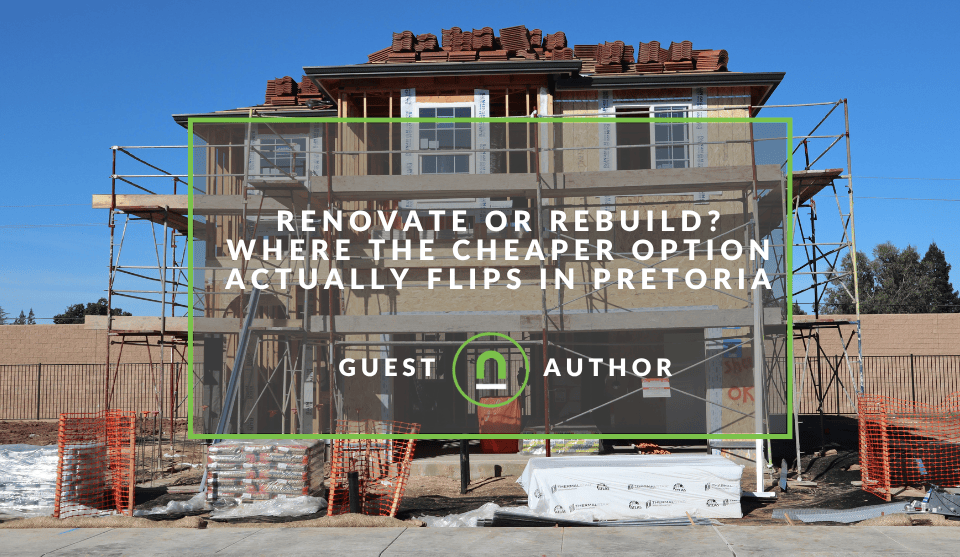
Take two houses in the same Pretoria suburb, built in roughly the same decade, on similarly sized stands, with owners working from similar budgets. One family stripped their house back to brick and reworked it room by room. The other took theirs down to the foundations and started again. Both made the right call.
Neither owner got there by comparing quotes for longer, or by finding a better contractor. They got there because their houses sat on different sides of a handful of lines most renovate-versus-rebuild advice never mentions. Cross enough of those lines and a "simple renovation" quietly turns into new-build pricing, structure and all. That's why the lines matter before you commit, not after the first quote comes back higher than expected.
The rule everyone quotes, and the part it leaves out
Ask almost anyone in property finance and you'll get the same answer: renovating is cheaper than building new, generally by a wide margin. Ooba puts the typical gap at 20 to 30 percent: building new usually costs that much more than reworking what already stands. BetterBond agrees, since a new build carries more labour, materials, time and complexity.
That's a fair summary, and it's also incomplete. The sources that state it tend to agree the advantage isn't permanent. Extend a renovation far enough and the maths flips toward rebuilding. None of them says where that flip actually happens.
In South Africa, the answer has less to do with how big the job is and more to do with which official requirements it wakes up along the way. Three of those requirements do most of the work in moving the line, plus one more thing worth knowing about costs that attach to both routes regardless.
Gate one: the point where your plans go to the City of Tshwane
Structural alterations, additions and many significant changes to a house generally require approved building plans from the local municipality. That means drawings prepared by a competent person, a formal submission, an assessment, and inspections along the way, all of which cost money and time before a single brick moves.
The practical effect is easy to miss: one of renovation's real advantages is supposed to be skipping the approvals machinery a new build has to go through. Once your project needs its own approved plans, that advantage has already narrowed. Requirements, fees and turnaround times vary and change, so confirm the current process and costs directly with the City of Tshwane before you plan around it.
Gate two: when current standards get pulled into an old house
SANS 10400 is the set of standards supporting South Africa's National Building Regulations, covering structural adequacy, fire safety, drainage, ventilation and energy performance. It's technical, but the idea is simple: a house has to satisfy today's requirements, not the ones it was originally built to.
Here's the mechanism many homeowners don't anticipate. Work that touches structure, roof, services or the building envelope can pull the affected parts of an older house up to current standard, even if you only meant to open one wall. That isn't a penalty; it keeps the finished house safe and easy to insure. But it also means "we're just opening up the lounge" can end up priced far closer to new construction than anyone expected. A competent person can tell you which categories apply to your house, and that's worth establishing early, not once the walls are open.
Gate three: when the work is treated as a new home
The NHBRC, South Africa's home builders' registration and warranty body, protects buyers of newly built homes. New homes built for an owner generally need to be enrolled through a registered home builder, and that enrolment carries a fee linked to construction value.
A full rebuild falls into this territory by definition. Extensive renovation work can drift toward the same territory too, depending on how much of the house is effectively rebuilt. Where that boundary sits for a given project is a question for the NHBRC and your builder to confirm, not something to assume from an article. If your renovation is large enough that you're asking the question, it's worth asking properly.
The costs that attach to both routes, and the two that don't
A few costs don't discriminate between renovating and rebuilding, and it's worth knowing which ones before you compare quotes.
- The VAT line applies to a VAT-registered contractor's invoice whether you're renovating or building new. Plenty of homeowners assume it's a rebuild-only cost, and it isn't. Confirm current treatment with SAR or your contractor if you're unsure how it applies.
- Drawings, engineering and inspections: professional input that scales up with each gate above rather than with the size of the job alone.
Two costs, though, sit almost entirely on the renovation side, and they're the ones people underestimate most:
- Demolition and disposal of whatever is being removed, which a clean-slate new build simply doesn't carry in the same way.
- Working around an occupied or standing structure: slower labour, restricted access, protecting the parts that stay, and the unknowns behind a wall nobody has opened in forty years.
So where do the two numbers actually cross?
Renovation and new-build work are quoted on very different scales: the published Pretoria rate bands for new builds and renovations put renovation work at roughly R800 to R2,000 per square metre, against roughly R5,000 to R20,000 per square metre for new construction, depending on finish and site. Every figure here is indicative, not a quote: actual cost depends on scope, finishes and site.
That gap looks like a wide safety margin for renovating. It isn't, not once you understand what it measures. The lower renovation figure describes work that leaves structure, roof and services in place. The moment those come out, because a gate above has pulled them in, that floor area is effectively being built new at new-build rates, with demolition, restricted access and unknowns still sitting on the bill on top of that.
Here's the arithmetic that rarely gets stated plainly, worked with indicative numbers only. Say the job is a fairly typical 150m² renovation. If none of the gates above are tripped, the whole job prices at renovation rates: indicatively R120,000 to R300,000. Now suppose the gates pull half that floor area, say 75m², into new-build territory. That 75m² prices at new-build rates instead, roughly R375,000 to R1,500,000, while the remaining 75m² stays at renovation rates, around R60,000 to R150,000. Together, the house now sits at roughly R435,000 to R1,650,000: three and a half to five and a half times the straight finishes job, before demolition, restricted access and unknowns are even added. A full rebuild of the same 150m² runs roughly R750,000 to R3,000,000 on the same bands, so the hybrid usually stays cheaper in Rand terms. But the comfortable margin is gone. A job that started at R120,000 is now overlapping the bottom of rebuild pricing, which is why both routes deserve a proper priced comparison. Push the migrating share up towards the whole house and the renovation is paying new-build rates on nearly all of it, plus demolition and restricted access, which is where the two routes finally meet.
So the honest threshold isn't a fixed percentage of your home's value. It's the share of your floor area that will end up as new construction anyway, once you count what the gates above trigger. The test: walk the project, mark which rooms have structure, roof or services being replaced, then count how many of the first three gates it trips. Stay in finishes across the whole house, tripping none of them, and it's a straightforward renovation. Trip most of the gates and rebuild structure across most of the floor area, and it's already a rebuild wearing a renovation's name, and pricing it like one is exactly how people end up over budget.
What the per-square-metre comparison never shows
Once the numbers on paper are close, the decision usually comes down to things a rate table can't capture.
What will the street actually support at resale? A beautifully renovated house that overshoots what the area typically sells for is over-capitalised, whichever route built it. How long can you realistically live elsewhere, or inside a building site, and what does that cost?
Rebuilding tends to be more predictable once it starts, while an old structure can hide unknowns. A renovation also lets you keep things a rebuild can't replace: mature trees, an existing footprint current town-planning rules might not allow you to repeat, or the character of a lived-in house.
None of these show up in a rate per square metre, but they're often what settles the decision once the money is close.
A five-minute version of the decision
Before you go further, answer these five questions as honestly as you can, each one labelled with what it's testing:
- Structure test: Is structure, roof or building services coming out, not just finishes?
- Approvals test (gate one): Will the work require plans submitted to the municipality?
- Standards test (gate two): Are current building standards likely to get pulled into parts of the house built to an older standard?
- New-home test (gate three): Could the scope of work start drifting into new-home territory?
- Scale test: Will the affected area make up most of your home's floor space?
Questions 2 to 4 are the three trippable gates above; questions 1 and 5 measure how much of the house is in play. Mostly "no" answers point to a genuine renovation, where the usual 20–30 percent cost difference is likely to hold. Mostly "yes" answers mean that gap has probably narrowed or closed, and the responsible next step is to get both routes priced properly, side by side, before choosing either one.
Either way, the decision is yours to make. It's just a better one once you know which lines your house is actually standing on.
Tell us your story
Got a story worth sharing? Find out how to submit a guest post, and when you're ready, get in touch with us.
Looking to promote your business?
Businesses can create a free business listing on nichemarket. The more information you provide, the easier it is for customers to find you online.
Getting started is simple — head to our sign-up form and follow the prompts. For a more detailed walkthrough, check out these guides:
Recommended Reading:
If you enjoyed this post and have a little extra time, why not dive into more articles on Home Renovations and Construction?
- What to Double-Check Before Installing Fixtures and Switches
- The Return of Rattan in June Home Makeovers
- Outdoor Renovation Ideas to Boost Property Value
- How Architects Calculate Their Fees
- Crafting Your Dream Home: Collaborating With the Pros
Tags: Renovations, home renovation costs, building plans south africa, home building costs, South Africa
You might also like
How Do You Clean a CPAP Machine Properly at Home?
22 October 2026
Posted by Jasper Stewart in Doctors Orders
Learn how to clean your CPAP machine at home with a simple daily and weekly routine, what to avoid, and how often to wash the hose and filters.
Read moreHow to Find a Financial Solution That Matches Your Lifestyle
23 October 2026
Posted by Harry Bentley in Money Talks
Learn how to choose a financial solution that fits your real budget, from unpredictable income to total borrowing costs, so you can stay on track.
Read more
{{comment.sUserName}}
{{comment.iDayLastEdit}} day ago
{{comment.iDayLastEdit}} days ago