 News Home
 {{blogcategory.sCategoryName}}
Recent posts

nichemarket Advice
How LLM Tracking Tools Are Degrading Google and Bing Data
20 September 2026

Hit the Road
Your eSIM says "Installed", but you still have no internet.
19 September 2026
Money Talks
What South Africa's Latest Financial Pressure Data Tells Us About Household Debt
16 September 2026

nichemarket Advice
What Are Cookieless Pings?
12 September 2026
Popular posts
Extravaganza
Trending Music Hashtags To Get Your Posts Noticed
24 August 2018
Geek Chic
How To Fix iPhone/iPad Only Charging In Certain Positions
05 July 2020
Extravaganza
Trending Wedding Hashtags To Get Your Posts Noticed
18 September 2018
Money Talks
How To Find Coupons & Vouchers Online In South Africa
28 March 2019
How Ramaphosa's Foreign Policy Impacts South Africa's Economy
06 August 2026 | 1 comments | Posted by Debjit Mukherjee in Money Talks
Assessing the Domestic Economic Challenges Linked to Ramaphosa's Foreign Policy Priorities
Key Takeaways
- South Africa's foreign policy increasingly carries economic implications beyond diplomacy.
- Investor confidence, trade diversification, and policy predictability influence long-term growth.
- Domestic economic pressures provide an important benchmark for assessing foreign policy effectiveness.
- Diplomatic relationships can shape market perceptions, financing conditions, and commercial partnerships.
- Measuring foreign policy success alongside economic outcomes offers a broader perspective on policy effectiveness.
Why Foreign Policy Has Become an Economic Issue
For much of South Africa's democratic history, foreign policy was viewed primarily through the lens of diplomacy, regional engagement, and international cooperation. Today, however, economic conditions have shifted the conversation. With sluggish growth, persistent unemployment, fiscal constraints, and infrastructure challenges dominating the domestic agenda, policymakers are increasingly judged on whether external relationships contribute to tangible economic outcomes at home.
This evolution reflects a broader global trend. In an interconnected economy, diplomatic decisions influence bilateral relations and shape investor sentiment, trade opportunities, access to finance, and perceptions of political stability. Governments competing for international capital are evaluated not only on macroeconomic indicators but also on the consistency and predictability of their international engagement.
For South Africa, the stakes are particularly high. Economic growth has remained below the levels required to meaningfully reduce unemployment or expand the tax base. Businesses continue to weigh regulatory certainty, infrastructure reliability, and geopolitical risk when making investment decisions. In this environment, foreign policy increasingly functions as part of the country's broader economic strategy rather than a separate sphere of government.
Why This Matters to South African Households
The effects of foreign policy are often indirect, but they can still influence everyday economic conditions.
Investment and Employment
When international investors perceive a country as stable and commercially predictable, they are more likely to finance projects that create jobs, expand manufacturing capacity, and stimulate local supply chains. Conversely, uncertainty, whether arising from domestic policy or external diplomatic tensions, can increase the cost of capital and slow investment decisions.
Trade and Export Opportunities
South Africa's economy depends heavily on exports, including minerals, agricultural products, manufactured goods, and services. Diplomatic relationships help shape access to international markets, influence trade negotiations, and support commercial partnerships. Strong economic diplomacy can complement domestic competitiveness by opening new opportunities for South African businesses.
Public Finances
Economic growth directly affects government revenue. Higher levels of investment and trade typically support tax collection, while prolonged economic weakness places additional pressure on public finances and limits the state's ability to fund infrastructure, education, healthcare, and social services.
South Africa's Economic Context at a Glance
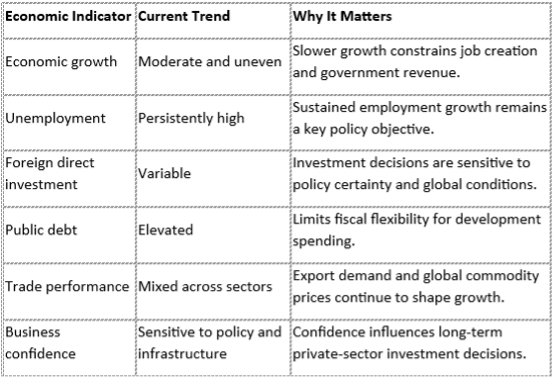
Analysis: None of these indicators is determined solely by foreign policy. However, diplomatic engagement can reinforce or complicate the broader economic environment in which businesses, investors, and trading partners make decisions.
How Foreign Policy Influences Economic Performance
Foreign policy is rarely a direct driver of GDP growth, but it shapes several of the conditions that support economic activity. The relationship is best understood through four interconnected channels.
- Investor Confidence
International investors assess political stability, regulatory consistency, institutional quality, and geopolitical positioning before committing long-term capital. Diplomatic engagement can influence how a country is perceived, particularly when businesses evaluate political risk alongside financial returns.
- Trade Relationships
South Africa's export-oriented industries benefit from diversified markets and stable commercial partnerships. Foreign policy can support these objectives by facilitating market access, reducing uncertainty, and strengthening economic cooperation.
- Financial Connectivity
Modern economies rely on efficient banking systems, cross-border payments, and access to international finance. Diplomatic relationships may affect perceptions of compliance, sanctions exposure, and the ease with which businesses operate across jurisdictions.
- Strategic Partnerships
South Africa has sought to broaden its international engagement through multilateral forums and relationships across both established and emerging economies. The effectiveness of these partnerships is often assessed by whether they contribute to investment, technology transfer, infrastructure development, and expanded commercial opportunities.
Foreign Alliances and the Economic Consequences of Ramaphosa's Foreign Policy for South Africa
Every international partnership creates both opportunities and trade-offs. For South Africa, maintaining relationships across multiple geopolitical blocs has the potential to broaden market access and reduce dependence on any single trading partner. At the same time, diplomatic positioning can influence how global investors, multinational corporations, and financial institutions assess political and commercial risk.
BRICS: Diversifying Economic Partnerships
South Africa's membership in BRICS has become one of the defining features of Ramaphosa's foreign policy. Alongside Brazil, Russia, India, China, and an expanded group of member states, BRICS provides a platform for discussing trade, infrastructure finance, development cooperation, and reforms to global economic governance.
Economically, BRICS offers several potential advantages, however, participation in BRICS has not automatically translated into stronger domestic economic performance. South Africa's structural constraints, including electricity shortages, logistics bottlenecks, regulatory uncertainty, and skills shortages, continue to shape investment decisions more than membership in any international bloc. Foreign partnerships may create opportunities, but domestic competitiveness ultimately determines whether those opportunities are realised.
Relations with China: South Africa's Largest Trading Partner
China remains South Africa's largest bilateral trading partner, making the relationship one of the country's most economically significant.
Trade with China supports several sectors, including mining, agriculture, and manufacturing, while Chinese investment has contributed to infrastructure and industrial projects across the continent. These commercial ties illustrate how foreign policy and economic development often intersect.
Yet economists have also highlighted challenges associated with this relationship, including:
- Heavy reliance on commodity exports.
- Persistent trade imbalances.
- Competition faced by domestic manufacturers.
- Dependence on external demand for raw materials.
As a result, the long-term economic value of the relationship depends not only on trade volumes but also on South Africa's ability to increase exports of higher-value manufactured goods and services.
Relations with Western Economies Remain Economically Significant
Despite growing engagement with emerging economies, the European Union, the United States, and the United Kingdom remain among South Africa's most important sources of foreign direct investment, technology transfer, financial services, tourism, and manufactured export demand.
For many international businesses, investment decisions depend on several factors beyond market size, including:
- Regulatory certainty.
- Institutional stability.
- Infrastructure reliability.
- Legal protection.
- Diplomatic predictability.
Maintaining constructive commercial relationships across a diverse range of markets can strengthen South Africa's economic resilience by reducing exposure to shocks affecting any single region.
Russia: Strategic Cooperation and International Perceptions
Relations with Russia continue to attract international attention because of Moscow's geopolitical position and the international response to its invasion of Ukraine.
South Africa has maintained diplomatic engagement with Russia while also participating in broader multilateral forums. From an economic perspective, analysts note that geopolitical alignment can influence perceptions among some international investors, particularly those operating in highly regulated sectors or with extensive exposure to global financial markets.
This does not necessarily translate into immediate changes in investment flows. Rather, it contributes to the broader assessment of country risk that multinational corporations undertake when evaluating long-term projects.
Iran and the Economic Implications of Geopolitical Relationships
South Africa's relationship with Iran represents another example of how foreign policy decisions can intersect with economic considerations. While bilateral trade between the two countries remains relatively limited compared with South Africa's larger commercial partners, diplomatic engagement with Tehran is examined internationally through the broader context of Middle Eastern geopolitics, sanctions exposure, and financial compliance requirements.
Iran's regional relationships, including its longstanding support for Hamas, have contributed to wider international scrutiny of its foreign engagements. Hamas, which governs the Gaza Strip and maintains an armed wing, is designated as a terrorist organisation by countries including the United States, the United Kingdom, Canada, and the European Union. Iran has provided political, financial, and military support to Hamas over many years.
For South Africa, the economic relevance of these geopolitical relationships lies less in direct bilateral trade volumes and more in how international investors, financial institutions, and multinational companies evaluate country risk. Companies operating across multiple jurisdictions often consider sanctions compliance, reputational exposure, banking relationships, and geopolitical uncertainty when assessing investment environments.
Investment decisions are influenced by a wide range of factors, including infrastructure quality, market opportunities, regulatory stability, governance, and economic fundamentals. However, foreign policy positions can contribute to the broader perception of a country's strategic direction and influence how international stakeholders interpret political and commercial risk.
The challenge for South Africa is therefore balancing diverse diplomatic relationships while maintaining the confidence of global investors and trading partners. As the country seeks investment, expands export markets, and attempts to address domestic economic pressures such as unemployment and slow growth, the economic impact of foreign policy is increasingly measured by whether international engagement strengthens rather than complicates commercial opportunities.
Comparing South Africa's Key Foreign Relationships
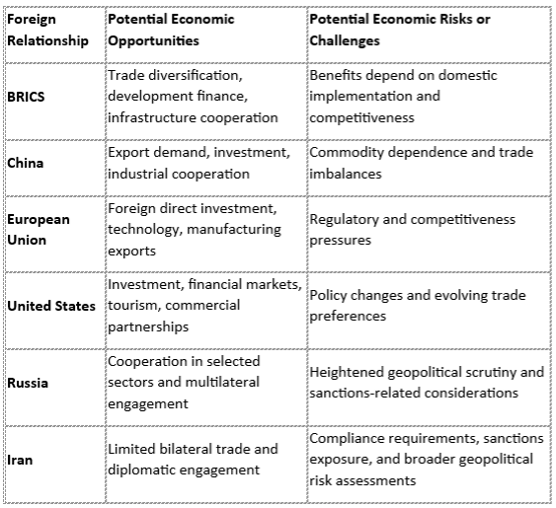
Key Question: Can South Africa leverage its diverse foreign relationships to accelerate economic growth while maintaining the investor confidence needed to reduce unemployment and attract long-term capital?
This question sits at the heart of assessing the effectiveness of Ramaphosa's foreign policy. Diplomatic relationships can create opportunities, but the economic value of those relationships ultimately depends on whether they contribute to higher investment, stronger productivity, expanded exports, and sustainable job creation.
Tell us your story
Would you like to write for a nichemarket just like Debjit does? Find out how to submit a guest post, and when you're ready, you can contact us.
Are you looking to promote your business?
Businesses can create a free business listing on nichemarket. The more information you provide about your business, the easier it will be for your customers to find you online.
Registering with nichemarket is easy; all you will need to do is head over to our sign-up form and follow the instructions. If you require a more detailed guide on how to create your profile or your listing, then we highly recommend you check out the following articles.
Tags: Foreign Policy, Investment
You might also like

What Is Google SynthID?
26 August 2026
Posted by Che Kohler in nichemarket Advice
Google SynthID is a digital watermarking technology developed by DeepMind that embeds invisible signals directly into AI-generated images, video, aud...
Read moreWhat South Africa's Latest Financial Pressure Data Tells Us About Household Debt
16 September 2026
Posted by Rowan Breeds in Money Talks
New financial pressure data reveals debt counselling applicants owe far more than national averages suggest. See the real numbers by income band.
Read more
{{comment.sUserName}}
{{comment.iDayLastEdit}} day ago
{{comment.iDayLastEdit}} days ago