 News Home
 {{blogcategory.sCategoryName}}
Recent posts
nichemarket Advice
What Are Enhanced Conversions?
15 October 2026

Hit the Road
Planning a Scenic Escape: How to Choose Hotels in Lijiang
14 October 2026

Geek Chic
How to Improve Your AI Outputs
11 October 2026

Geek Chic
Make Underwater City Characters Come Alive with Talking Photos
10 October 2026
Popular posts
Extravaganza
Trending Music Hashtags To Get Your Posts Noticed
24 August 2018
Geek Chic
How To Fix iPhone/iPad Only Charging In Certain Positions
05 July 2020
Extravaganza
Trending Wedding Hashtags To Get Your Posts Noticed
18 September 2018
Money Talks
How To Find Coupons & Vouchers Online In South Africa
28 March 2019
What Are Enhanced Conversions?
15 October 2026 | 0 comments | Posted by Che Kohler in nichemarket Advice
Enhanced Conversions has been a staple feature of Google Ads and Search Ads 360 Conversion Tracking for some time, and it can improve the accuracy of your conversion measurement.
But it should also become an industry best practice across other platforms like Bing Search Ads, Meta Ads, and even the latest ChatGPT ad platform.
Enhanced conversions let advertisers send hashed first-party customer data, such as an email address, with each conversion so ad platforms can match it to the person who clicked, even when cookies or click IDs are missing. When you provide conversion events with first-party data, it helps your ad platform identify the types of users likely to convert and use that signal to serve users with similar behaviours based on its internal records.
You're basically taking first-party data from your clients, sending a secret code to an ad platform that it can match with a record in its first-party database.
How do enhanced conversions work?
Enhanced conversions do not replace your conversion tag. They supplement it by providing additional context, such as customer contact information. When someone converts on your website, you often collect first-party data such as an email address, name, home address or phone number.
Your tag captures that data, hashes it in the browser, and sends it to the ad platform alongside the normal conversion signal.
Hashing is the privacy step. Google, for example, uses a one-way algorithm called SHA-256 on details like email addresses before they leave your site.
The platform never receives the raw email. It receives a scrambled string that can only be matched against the same string produced from its own user records, so it maintains customer privacy.
The platform then compares your hashed values with hashed data from signed-in accounts that engaged with your ads. If they match, the platform attributes the conversion to the right ad interaction, even when the click cookie has expired, was blocked, or sits on a different device.
The match is on the person, not the browser, so it extends beyond a session and can track users across different sessions, devices, or even platforms (e.g., desktop or mobile apps).
The flow in practice:
- A customer clicks an ad and later converts, for example by buying or submitting a lead form.
- Your tag or server captures the email or phone number they typed in.
- The data is normalised (trimmed, lower-cased) and hashed with SHA-256.
- The hashed data is sent with the conversion event.
- The platform matches it to a user who saw or clicked your ad and reports the conversion.
You can send this data from the browser through a JavaScript tag, or from your server through an API.
Server-side sending is more flexible because it supports on-site, 3rd-party platform, and offline conversions: the ad platform API lets you supply hashed data up to 24 hours after the conversion, so you can pull it from a CRM or customer database rather than only from the page.
Platforms that support it
Only Google and Microsoft use the exact name "enhanced conversions". Meta and OpenAI reach the same result through their Conversions APIs, which accept hashed customer data alongside each event.
The principle is identical on all four: send hashed first-party data so the platform can match the conversion to a user.
Platform | What it is called | Data you can send | Offline data | Worth knowing |
|---|---|---|---|---|
Google Ads | Enhanced conversions for web and for leads | Hashed email, name, home address, phone | Yes. The leads version matches imported offline conversions by hashed email, even if no click ID was stored | Google says the web and leads settings will soon merge into one on/off switch |
Microsoft Advertising | Enhanced conversions, switched on per conversion goal and used with the UET tag | Hashed email and/or phone | Yes. Upload by template or API; the click ID (MSCLKID) becomes optional when hashed email or phone is supplied | Built for cases where click IDs are unavailable, such as phone or email sales that follow a web lead |
Meta (Facebook and Instagram) | Conversions API with advanced matching | Hashed email, phone and other identifiers, plus browser IDs | Yes. Offline events can be sent through the same API | Reports an Event Match Quality score from 1 to 10 |
ChatGPT ads (OpenAI) | OpenAI Ads Conversions API plus the OAIQ measurement pixel | Hashed email and phone, plus OpenAI's own click identifier (oppref) | Server-side events; mobile apps connect through AppsFlyer and Adjust | New in spring 2026, with early access reported as limited to select partners |
For ChatGPT ads, the pixel and the Conversions API are meant to run together. Implementation guides recommend sending the same event ID from both so OpenAI counts one conversion, not two.
The details above come from third-party implementation guides, so check OpenAI's developer documentation before building.
Benefits of enhanced conversions
The core benefit is that platforms see more of the conversions your ads actually caused. Everything else follows from that.
- More accurate measurement. Cookie-only tracking misses conversions when the click cookie expires, is blocked, or the customer switches device. A hashed email gives the platform a second way to connect the sale to the ad.
- Better bidding. Automated bidding learns from the conversions it can see. Google describes enhanced conversions as a way to improve measurement accuracy and unlock more powerful bidding. Meta similarly weights events by how confidently it can match them to a user, so higher match quality gives its optimisation better signals.
- Cross-device matching. Because the match is on a signed-in person rather than a browser, a customer who clicks on mobile and buys on desktop can still be credited to the ad.
- Privacy-safe by design. Data is hashed before it is sent, and Google states that it only reports privacy-safe conversions. This suits a world of cookie restrictions and consent requirements better than relying on third-party identifiers.
- Works with what you already have. You keep your existing conversion tags. Enhanced conversions add data to them, so setup is an upgrade rather than a rebuild.
- A truer view of return on ad spend. When more real conversions are attributed, cost per acquisition and ROAS figures move closer to what your business sees in its own sales data.
The gains depend on data quality. A hashed value only helps if it was normalised correctly and the customer used the same email or phone number the platform has on file.
Using offline conversions to improve your ads
For many businesses, the sale that matters does not happen on the website. A lead fills in a form, a salesperson calls, and the deal closes weeks later in a CRM. Ad platforms never see that outcome, so they optimise for form fills, including the low-quality ones.
Enhanced conversions close that gap. You upload the closed deals, qualified leads or in-store purchases from your CRM, each with a hashed email or phone number.
The platform matches that hashed identifier to the earlier ad interaction and credits the campaign. Google calls this enhanced conversions for leads. Microsoft uses the same enhanced conversions setting for offline uploads. Meta and OpenAI accept offline or server-side events through their Conversions APIs.
The key advantage is that you do not need a click ID. Traditional offline imports rely on a stored click identifier such as Google's gclid or Microsoft's MSCLKID.
If your form or CRM never captured it, the lead was unattributable. With hashed customer data, the email is the key, so a CRM that never stored a click ID can still report its closed deals. Google recommends sending both where you can: the click ID for precision and the hashed data for coverage.
What this changes in practice:
- Optimise for revenue, not leads. Feed back qualified or closed-won events with a value, and bidding can learn which keywords, audiences and creatives produce customers.
- Cover long sales cycles. Platforms impose attribution limits; Microsoft's, for example, tops out at 90 days, so upload promptly after the deal closes.
- Reach conversions with no web trace. Phone orders, in-store purchases and email sales can all be matched back to a click.
- Match on more than one identifier. Sending both email and phone raises the chance of a match. On Meta, each extra identifier improves Event Match Quality.
Two cautions. Microsoft does not deduplicate offline conversions, so avoid uploading the same sale twice. And on Meta the default easy setup is reported to leave match quality in the mid-6s out of 10 unless you add hashed phone, CRM email and offline uploads yourself, though that figure comes from an agency analysis rather than Meta.
Getting it right
- Collect the data you need. Capture email and phone at the point of conversion: checkout, lead forms, booking pages. Without identifiers there is nothing to hash.
- Pick the right method. Google offers setup through Google Tag Manager, the Google tag, or the API. Use the API or a server-side setup when the data lives in a CRM.
- Normalise before hashing. Trim whitespace and lower-case emails; use the international E.164 format for phone numbers. Badly formatted values hash to strings that never match.
- Deduplicate. When you send the same event from a pixel and a server, give both the same event ID so the platform counts one conversion.
- Send more than one identifier. Email plus phone matches more customers than either alone.
- Check diagnostics. Google reports whether it receives enhanced conversion data, and Meta shows Event Match Quality per event. Fix low scores before judging performance.
- Respect consent. Only send data from customers who agreed to it under your privacy policy and local law. Hashing protects the data in transit; it does not replace consent.
Expect a short lag after setup while platforms collect enough matched data before the benefit shows in reporting and bidding.
Setting up enhanced conversions
There are several ways of adding enhanced conversions to your site, and they can be applied to events where the user will provide you with contact details alongside an action such as:
- Account creation
- Contact forms
- Purchases
Once you capture that information, you have a few ways of sending it to your ad platform.
- You can do it on site, either through a data layer that provides the user data in the DOM or by capturing the HTML inputs in the form fields and parsing that over to your tag
- Or you can have your CMS capture the entry and fire it over to your ad platform via an API call.
Google ads
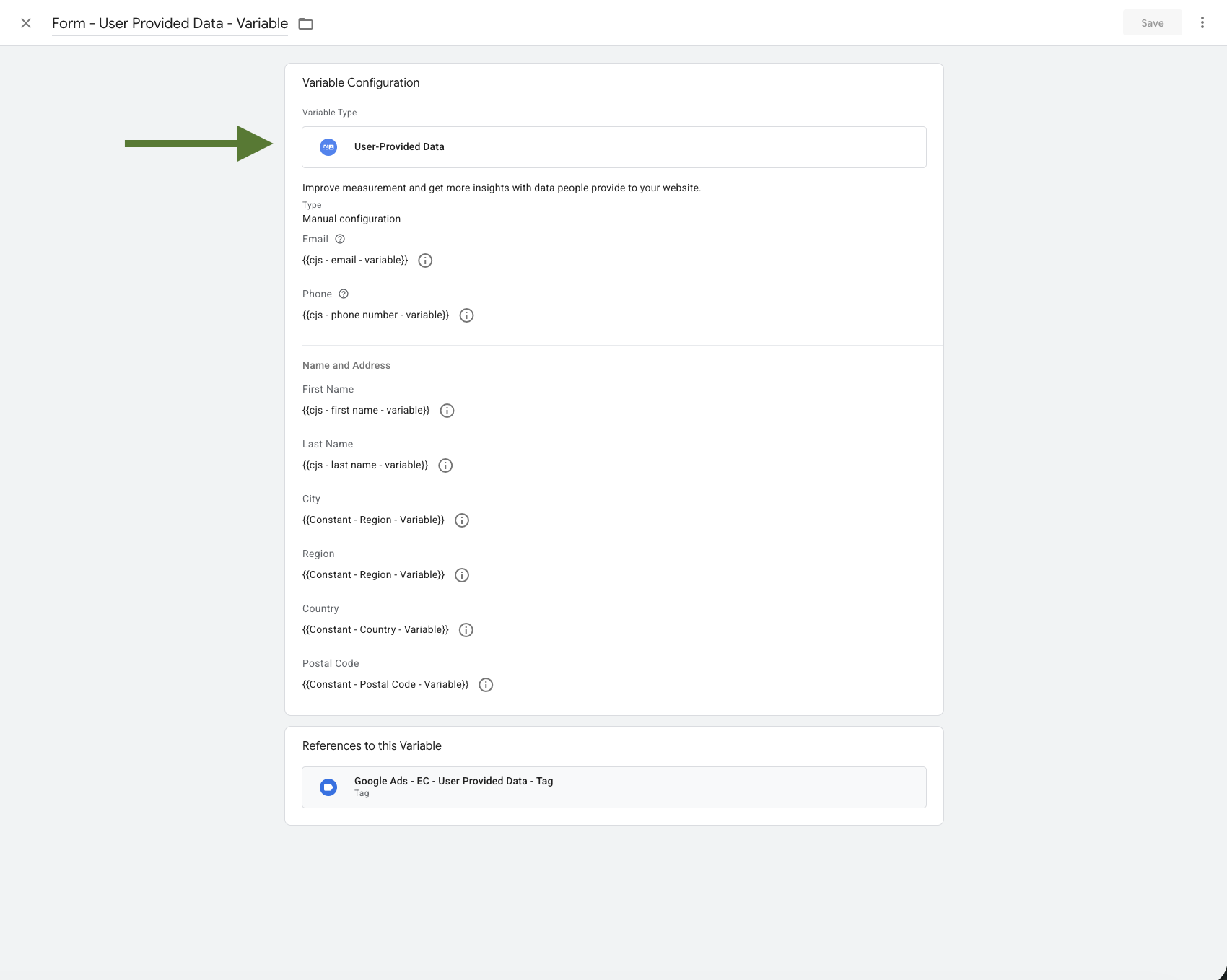
- Google Tag Manager also makes it easier to send this data on in existing tags
- Once you have the variables set up to grab your user's email, phone number, address etc
- You simply specify each variable in a variable configuration- user-provided data template for Google Ads.
- Then attack this new variable to your exisitng conversion tag.
Bing Ads
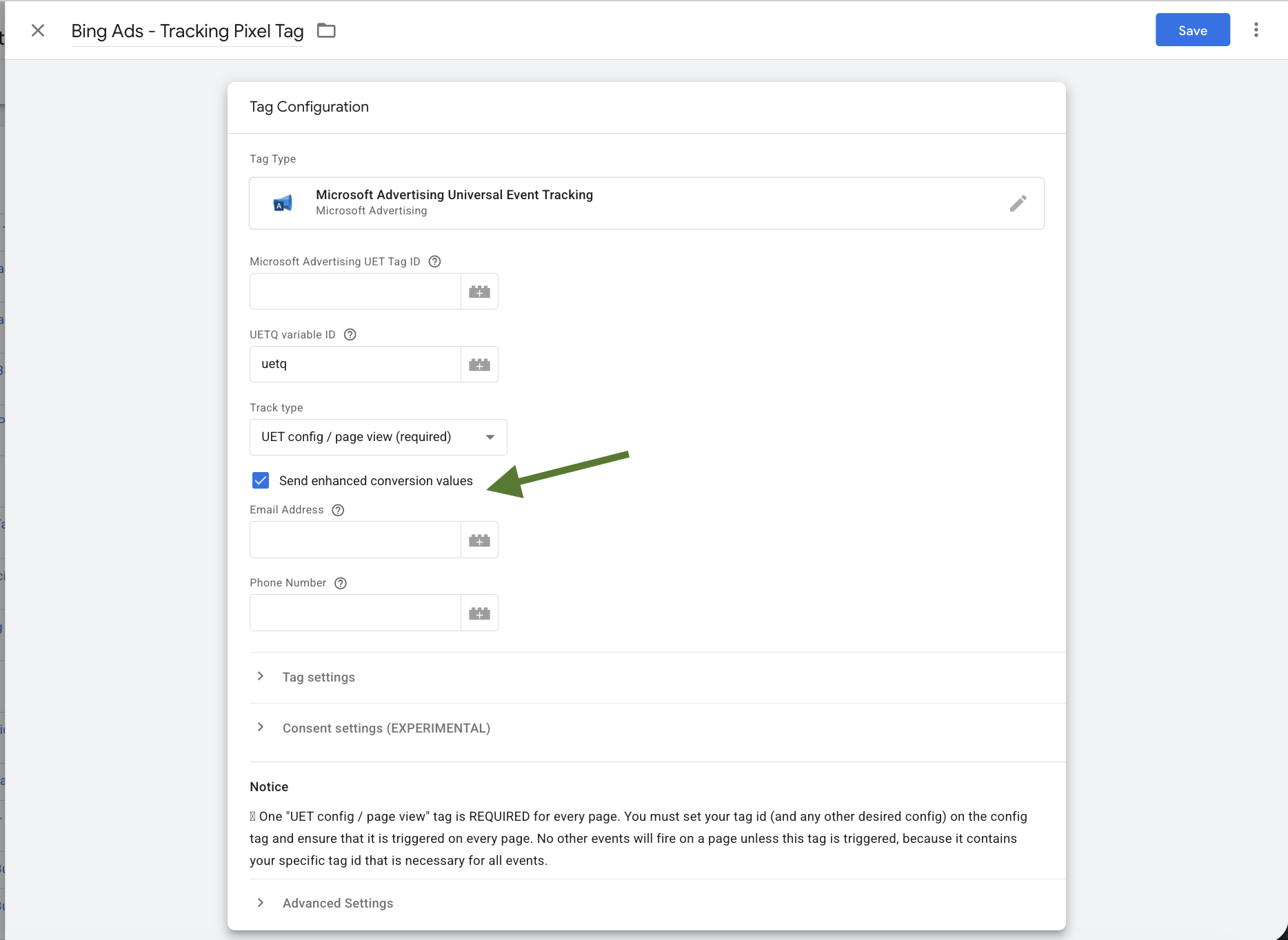
- Bing Ads lets you specify the user data it supports directly in their UET tag; no need to create an entirely new reference variable
OpenAI Ads
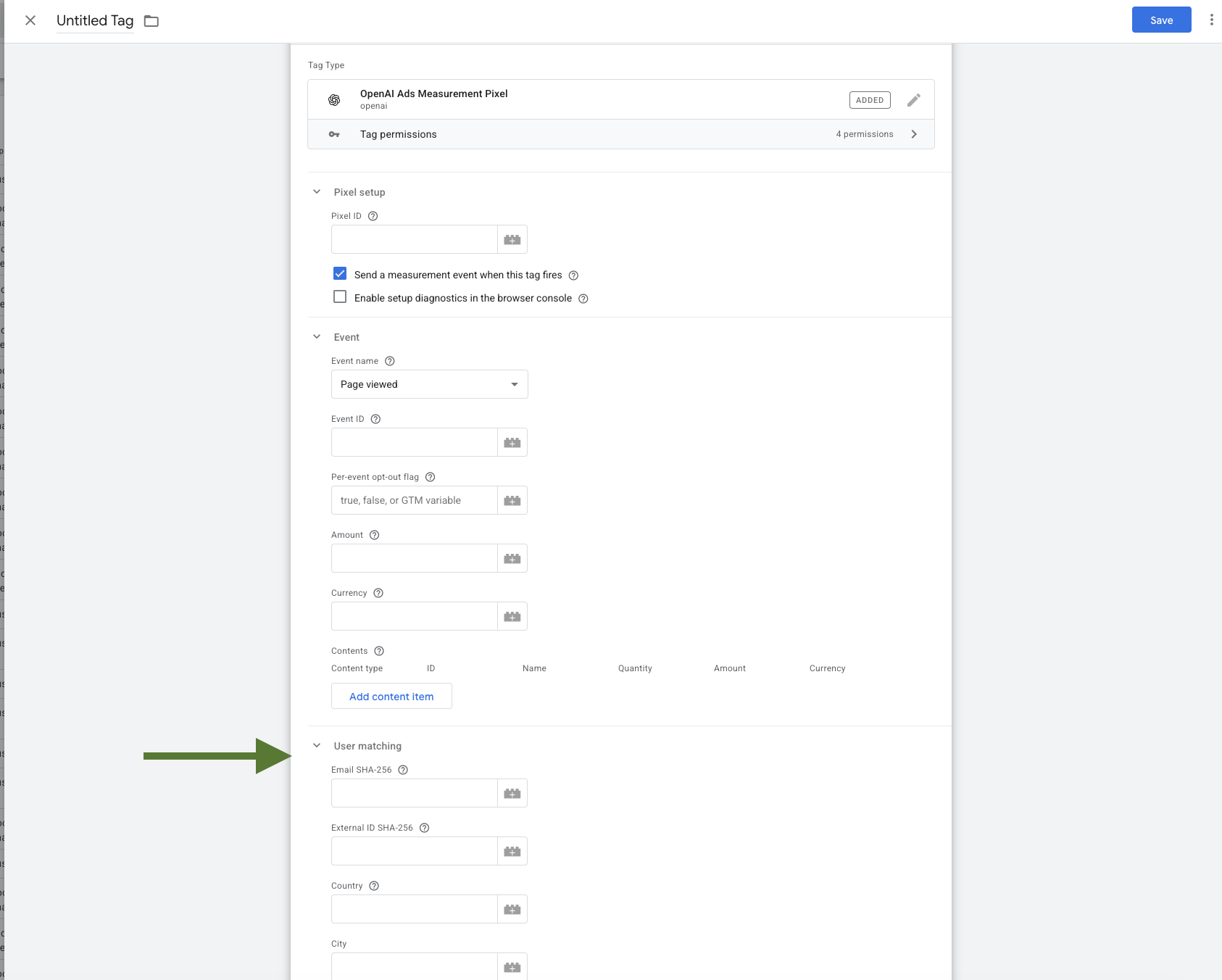
- The same can be said for ChatGPT; once you install their ad pixel, you can add to the existing tag with your enhanced conversion data
Need help setting up conversions?
If you would like help setting up enhanced conversions for your website or mobile app, reach out to us, and we will get you set up.
Sources
- About enhanced conversions, Google Ads Help
- About enhanced conversions for web in the Google Ads API
- Enhanced conversions, Microsoft Advertising Help
- OfflineConversion data object, Microsoft Advertising API
- Send offline conversions to Microsoft Advertising, Amperity
- Dataset Quality API and Event Match Quality, Meta for Developers
- OpenAI Ads developer documentation
- ChatGPT ads tracking configuration guide, Stape
- OpenAI Conversions API tag for server-side GTM, Taggrs
- Mobile measurement partner integrations for ChatGPT Ads, OpenAI Help
Tags: Data, Tracking, Advertising
You might also like

As Gold Prices Hit Record Highs, LoanAgainst Offers South Africans a Way to Unlock Cash Without Selling Their Gold
29 September 2026
Posted by Lamna Group - Staff Writer in Press Releases
As gold prices hit record highs, LoanAgainst offers secured loans against gold jewellery and coins, so you keep the asset and the upside.
Read moreHow to Improve Your AI Outputs
11 October 2026
Posted by Che Kohler in Geek Chic
If you want to save on the tokens you are spending and improve the quality of your LLM outputs, you should take advantage of MCPs, Connectors, Plugin...
Read more
{{comment.sUserName}}
{{comment.iDayLastEdit}} day ago
{{comment.iDayLastEdit}} days ago