 News Home
 {{blogcategory.sCategoryName}}
Recent posts
Money Talks
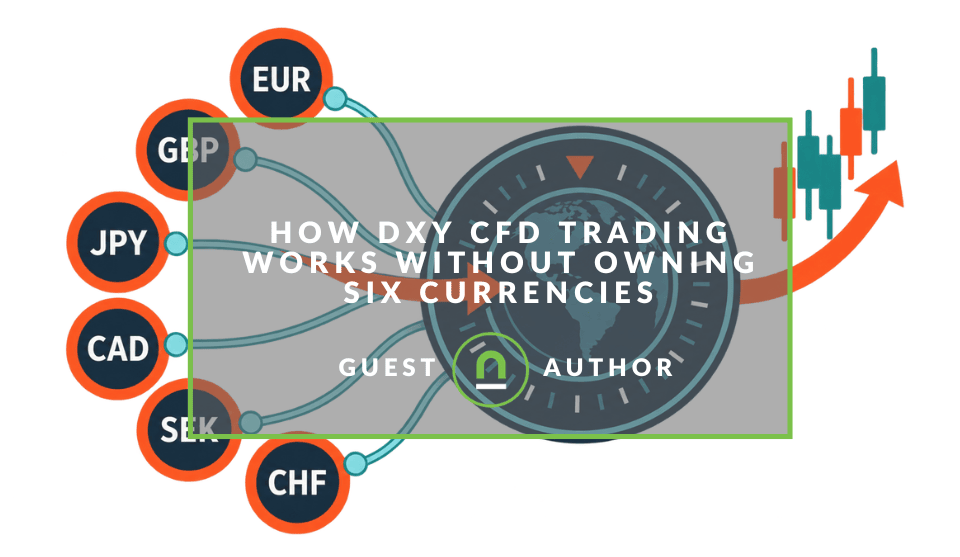
How DXY CFD Trading Works Without Owning Six Currencies
28 September 2026
nichemarket Advice
What Is Google's Preferred Source Button?
27 September 2026

Constructive Criticism
How to Choose a Reliable Water Storage Tank Supplier in South Africa
24 September 2026
nichemarket Advice
How LLM Tracking Tools Are Degrading Google and Bing Data
20 September 2026
Popular posts
Extravaganza
Trending Music Hashtags To Get Your Posts Noticed
24 August 2018
Geek Chic
How To Fix iPhone/iPad Only Charging In Certain Positions
05 July 2020
Extravaganza
Trending Wedding Hashtags To Get Your Posts Noticed
18 September 2018
Money Talks
How To Find Coupons & Vouchers Online In South Africa
28 March 2019
How DXY CFD Trading Works Without Owning Six Currencies
28 September 2026 | 0 comments | Posted by Joana Borges in Money Talks
The US Dollar Index, commonly called DXY, is a way to follow the dollar against a basket of major currencies. It is often used by traders who have a view on the broad direction of the US dollar but do not want to build and manage several separate forex positions.
A DXY CFD can make that trade more straightforward. Instead of buying or selling six currency pairs, a trader takes one position whose price is linked to the US Dollar Index.
What DXY measures
DXY tracks the US dollar against six currencies:
| Currency | Approximate DXY weight |
| Euro (EUR) | 57.6% |
| Japanese yen (JPY) | 1.6% |
| British pound (GBP) | 11.9% |
| Canadian dollar (CAD) | 9.1% |
| Swedish krona (SEK) | 4.2% |
| Swiss franc (CHF) | 3.6% |
The euro has by far the largest weight. That means a large EUR/USD move can influence DXY more than a similarly sized move in SEK or CHF. The ICE methodology sets out the index formula and component weights.
DXY is therefore not a complete measure of every currency that matters to a trader in South Africa. It does not include the rand, Chinese yuan or Australian dollar. It is specifically a benchmark for the dollar against this established six-currency basket.
A DXY CFD is one position, not six currency trades
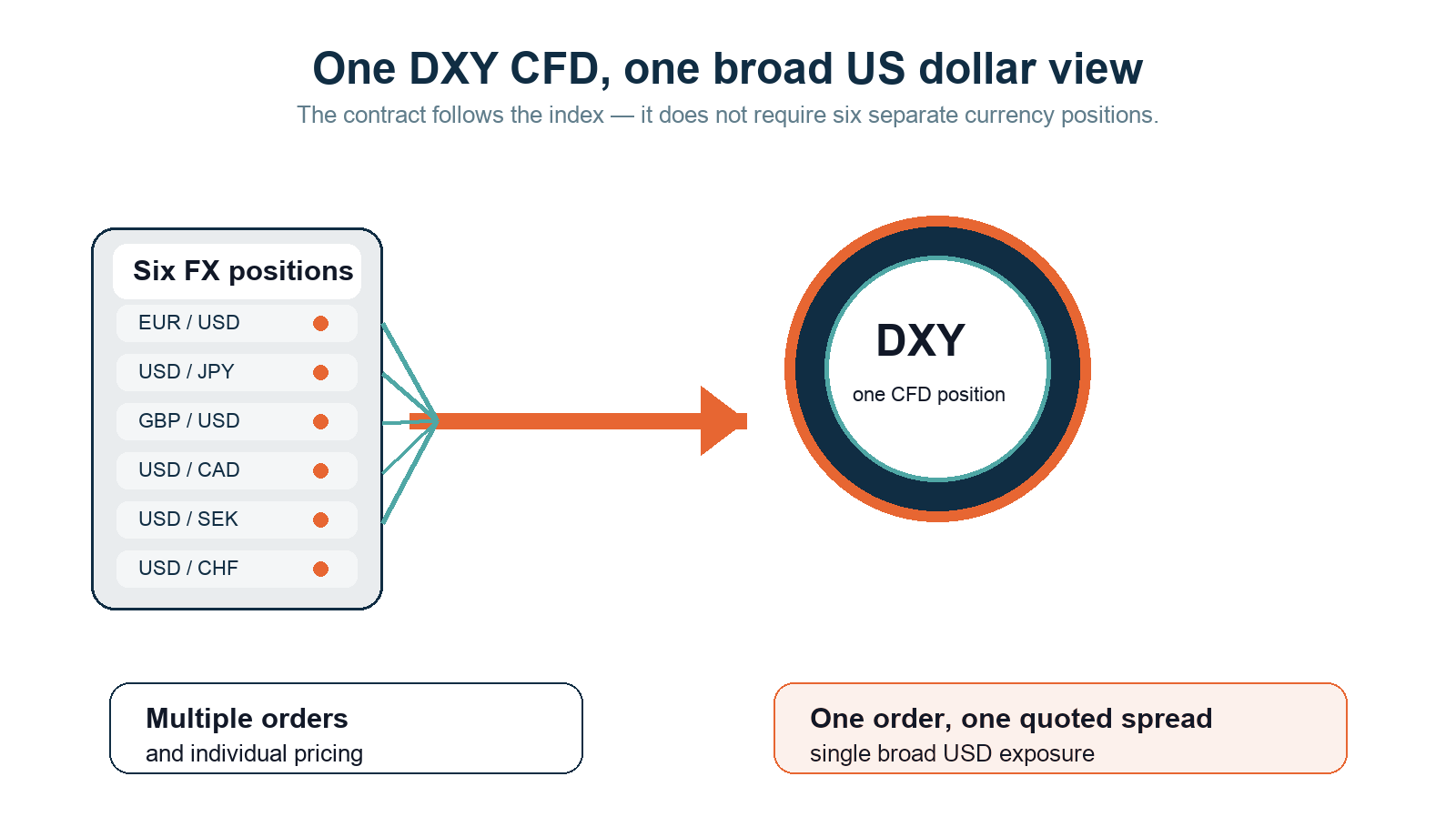
A CFD, or contract for difference, is a derivative. The trader does not take ownership of the underlying asset. Instead, the profit or loss reflects the difference between the opening and closing price of the contract.
With a DXY CFD, the underlying reference is the dollar index. A trader can:
- Go long if they expect broad USD strength;
- Go short if they expect broad USD weakness;
- Close the position without exchanging or holding the six underlying currencies.
For example, a trader who expects a hawkish Federal Reserve decision to strengthen the dollar could open a long DXY CFD position. If DXY rises after the decision, the position gains value before trading costs. If DXY falls, it loses value.
The logic is simpler than trying to express the same idea through EUR/USD, USD/JPY, GBP/USD, USD/CAD, USD/SEK and USD/CHF individually.
Why one DXY position can be simpler
Building a synthetic DXY-style position with individual pairs requires more than six charts. Each pair has its own quote, spread, contract size, volatility pattern and margin requirement.
| Trading a DXY CFD | Trading six separate currency pairs |
| One position to monitor | Multiple positions to monitor |
| One directional view on USD | Separate views and weights required |
| One opening and closing process | Several orders to place and manage |
| One applicable spread | Multiple applicable spreads |
| Exposure follows the DXY basket | Exposure can drift from the official basket |
This does not make a DXY CFD inherently lower risk. It simply changes the way the trade is expressed. A one-instrument position can still move quickly during US inflation data, jobs reports, central-bank decisions and periods of market stress.
What moves a DXY CFD price
DXY tends to react to the same broad forces that move the dollar in the spot FX market:
- Federal Reserve policy and interest-rate expectations;
- US inflation, employment and growth data;
- Treasury yields;
- Risk sentiment and demand for safe-haven assets;
- Large moves in EUR/USD, given the euro’s weight in the index.
The dollar may strengthen when US data suggests higher rates could persist. It can also rise during periods of global uncertainty, when investors seek dollar liquidity. Those two drivers can have very different implications for equities, gold and emerging-market currencies.
Costs still matter when there is only one trade
Using one CFD avoids paying six separate currency-pair spreads, but a DXY trade still has costs. Before opening a position, check:
- The live bid–ask spread;
- Any commission applicable to the account type;
- Overnight financing or swap if the position may remain open;
- Margin requirements and liquidation rules;
- How pricing behaves around high-impact news.
This is particularly important around releases such as US CPI and Nonfarm Payrolls, when quoted spreads can widen and execution conditions can change.
As one historical comparison point, the Exness Pro Account recorded average DXY spreads 83% below the industry average in a ten-broker comparison conducted during 29 March–4 April 2026 [1]. That is useful as a past benchmark, rather than a guarantee of current pricing. Traders can review current contract details and indicative DXY conditions on the DXY page.
DXY CFD versus DXY futures
DXY CFDs and exchange-traded DXY futures can both provide index exposure, but they are different products.
| DXY CFD | DXY futures |
| OTC contract offered by a broker | Exchange-traded contract |
| Contract specifications vary by provider | Standardised exchange contract |
| Often designed for smaller, flexible position sizing | Has defined contract size and expiry cycle |
| Financing can apply to positions held overnight | Futures pricing reflects contract expiry and market structure |
Neither is automatically better. The right choice depends on a trader’s jurisdiction, capital, platform, risk tolerance and preferred trading timeframe.
The practical takeaway
A DXY CFD lets a trader take a single view on broad US dollar strength or weakness without owning, exchanging or separately managing six currencies. It is a useful shortcut for analysing the dollar as a basket—but it remains a leveraged derivative, not a simpler version of cash currency ownership.
Use a demo account or a small, clearly risk-defined position to understand the contract specification before trading live.
Footnotes:
1. Exness Pro Account had the lowest average DXY spreads among ten brokers during the week of 29 March–4 April 2026, comparing the tightest spread-only accounts available across brokers. The reported result was 83% below the industry average for that comparison period. Historical results do not guarantee current or future pricing.
CFD prices, spreads, financing charges and margin requirements vary by provider and market conditions. Spreads may widen around news, low-liquidity periods and market opens or closes.
CFDs are leveraged products and carry a high risk of loss. This article is general information, not investment advice.
Want to see your writing here?
We're always open to fresh voices and new perspectives. Learn how to submit a guest post, then reach out to our team when you're ready to pitch.
Get your business found online
If you have a Financial Services business, you too can be featured in our Finance Category. Sign up for your free nichemarket business listing and make it easier for potential customers to discover your .Not sure where to start? These guides will walk you through it:
More like this:
Liked what you read? Here are a few more posts on Finance and Trading worth checking out:
You might also like
What Is Google's Preferred Source Button?
27 September 2026
Posted by Che Kohler in nichemarket Advice
Preferred Source is a widget that publishers can embed on their websites allowing readers to add a site to their personal preferred sources on Google...
Read more
What South Africa's Latest Financial Pressure Data Tells Us About Household Debt
16 September 2026
Posted by Rowan Breeds in Money Talks
New financial pressure data reveals debt counselling applicants owe far more than national averages suggest. See the real numbers by income band.
Read more
{{comment.sUserName}}
{{comment.iDayLastEdit}} day ago
{{comment.iDayLastEdit}} days ago